
Control in pickleball comes from three things working together: a core that absorbs impact instead of throwing it back at you, enough twist weight to keep the face stable on off-center contact, and a swing weight low enough to let your hands move faster than the rally demands. A thicker core (14 mm or above) with a forgiving sweet spot is the starting point. From there, face material and weight distribution refi ne what you feel. Here is what each variable does, why it matters more than power for most players, and how to pick a paddle that plays defense as well as you do.
What does control actually mean at the kitchen line?
People use "control" like it means one thing. It does not. Control is a collection of mechanical outcomes that let you place the ball where you intend, at the speed you intend, even when you are under pressure.
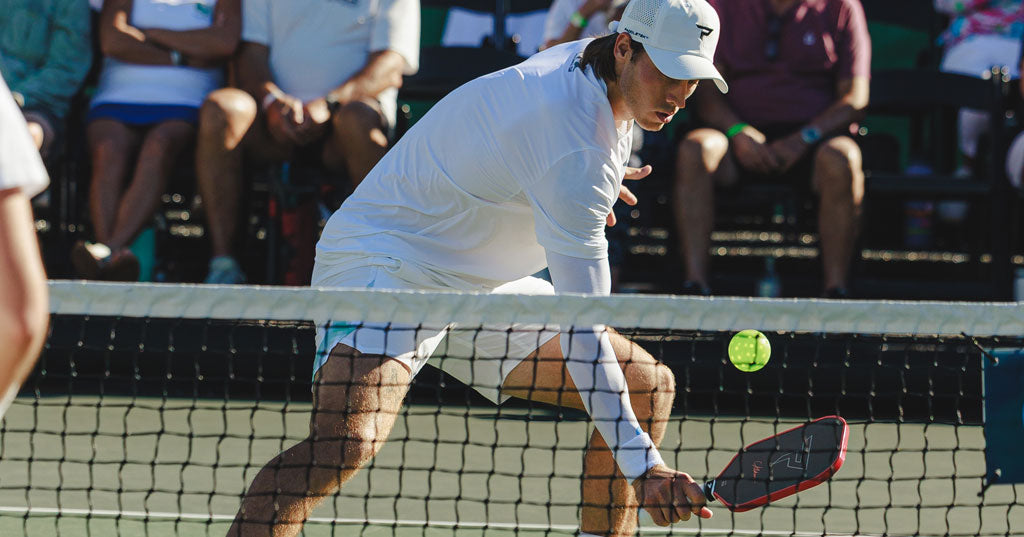
At the kitchen line, exchanges happen in roughly 300 to 400 milliseconds. You are standing 14 feet from your opponent. The ball is coming off a rigid carbon face, not a forgiving string bed. You do not get a full backswing. You barely get a quarter swing. In that window, your paddle has to absorb the incoming energy and give it back in a measured, directed way.
That is the opposite of what a power paddle does. A power paddle returns energy fast: thin core, quick rebound, maximum pop. Great for drives from the baseline. Terrible for the soft game, where the goal is to take speed off the ball and drop it into a precise spot.
Control-oriented paddles do three specific things differently. They compress more on impact (longer dwell time), they resist twisting when you catch the ball off-center (higher twist weight), and they feel stable without feeling sluggish (moderate swing weight). None of these show up as a single spec on a product page. But together, they are the difference between a reset that lands in the kitchen and a pop-up that gets put away.
The Power vs. Control Tradeoff
Read MoreHow does dwell time affect your touch?
Dwell time is how long the ball stays on the paddle face during contact. We are talking about milliseconds, not seconds. High-speed camera testing (including footage analyzed by The Dink) has shown that the actual difference between a "control" paddle and a "power" paddle is measured in fractions of a millisecond. That sounds insignificant. It is not.
In those fractions, a thicker core compresses slightly more under the ball. That compression does two things: it absorbs incoming energy (so the ball comes back slower and softer) and it lets the ball sit on the face just long enough for your stroke path to influence direction and rotation. A thinner core compresses less, rebounds faster, and gives the ball back with more pace. Great for a drive. Bad for a third-shot drop.
Here is the honest version of how this works. You cannot consciously "feel" the difference between 1.8 and 2.1 milliseconds of contact. What you feel is the downstream result: a shot that goes where you aimed versus one that pops up with more pace than you wanted. The core is doing physics. Your hands are interpreting the outcome.
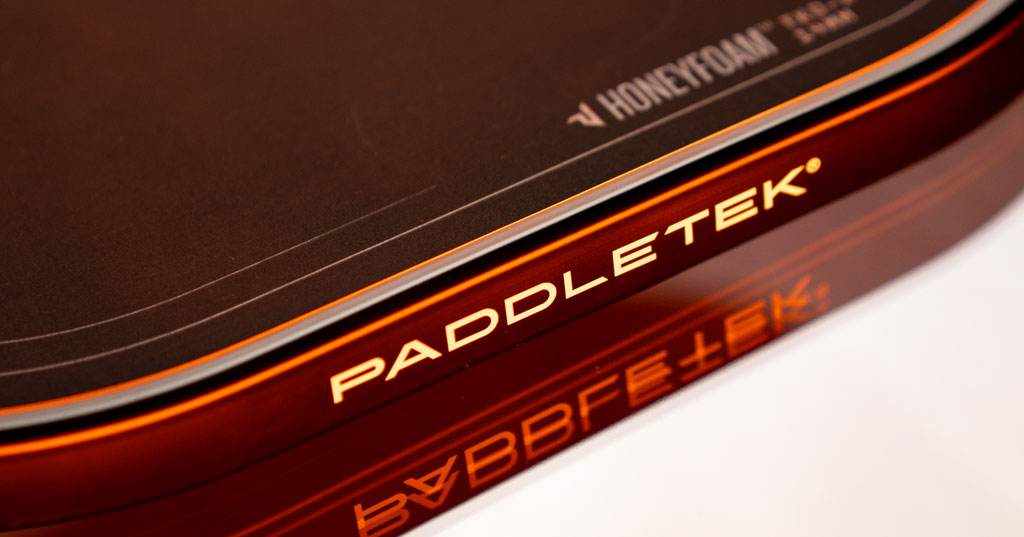
Paddletek's 14.3 mm honeycomb polymer core (available across the Bantam C-series) is built for this. The thicker profile compresses more than the 12.7 mm option and delivers a larger effective sweet spot. The Honeyfoam line takes it further with a full-foam core at 14 mm that dampens vibration even more aggressively, giving you a soft, connected feel on every contact.
Both are valid paths to control. The Bantam gives you raw feedback: you feel exactly what the ball does, and the paddle rewards clean technique. The Honeyfoam smooths the signal: it forgives slight mishits and reduces the harshness that builds up over long sessions. Which one you prefer depends on whether you want information or comfort from your paddle.
 How Honeyfoam and Bantam Compare
Why does twist weight matter more than most players realize?
Twist weight measures how well your paddle resists rotating when you hit the ball off-center. Every player hits off-center. The question is what happens next.
A paddle with low twist weight (under 6.0) torques in your hand on a mishit. The face opens or closes unpredictably. Your reset sails long or dumps into the net. You feel a jolt in your wrist. A paddle with high twist weight (6.5 and above) holds its angle. The face stays where you put it. Your mishit still lands somewhere useful.
In practical terms, twist weight is the size of your sweet spot. Not the geometric center of the face, but the area where contact produces a predictable result. Wider paddles naturally have higher twist weight because more mass sits at the perimeter. The Paddletek Bantam GTO-C, with its hybrid shape (16.25" x 7.75"), delivers a twist weight of 6.7 to 7.5, which is solidly in the forgiving range. An elongated paddle like the Bantam TKO-C trades some of that width for reach, concentrating mass closer to the center axis and lowering twist weight. Reach versus forgiveness. That is the tradeoff.
For a control player, especially one managing arm discomfort, twist weight deserves more attention than static weight. A stable face on off-center contact means less shock transmitted to your wrist and elbow on every rally.
What makes a paddle arm-friendly?
 Tennis elbow and wrist strain in pickleball come from the same source: repeated vibration and shock traveling from the paddle face through the handle and into your arm. Every contact sends energy in two directions. Some goes into the ball. The rest goes into you.
Three paddle characteristics reduce how much of that energy reaches your joints.
Core thickness. Thicker cores absorb more impact before rebounding. A 14.3 mm core dampens significantly more vibration than a 12.7 mm core of the same material. A full-foam core like Honeyfoam dampens even more because foam compresses progressively rather than rebounding sharply the way honeycomb polymer does.
Twist weight. Off-center hits generate the nastiest shock because the paddle torques in your hand instead of absorbing the impact cleanly. Higher twist weight reduces that torque. A wider paddle shape with more perimeter weight is inherently kinder to your arm on mishits.
Swing weight. A paddle that is too heavy in motion forces your shoulder and elbow to absorb more rotational force on every stroke. For players managing joint issues, keeping swing weight moderate (under 115) reduces cumulative stress over a two-hour session without sacrificing the stability you need.
None of this replaces rest, proper warm-up, or technique adjustments (looser grip pressure is the single cheapest fi x for elbow pain). But the right paddle makes the difference between playing through discomfort and playing without it.
Paddletek's Shot Protection Edge System, built into the Bantam and Honeyfoam lines, adds a shock-absorbing layer around the perimeter that reduces vibration on edge contact. Combined with a thicker core and the natural dampening of either the QRT polymer or full-foam construction, these paddles are designed to let you play longer with less cost to your body.
See How Paddletek's 12.7 mm and 14.3 mm Cores Differ
Read MoreWhat specs should a control player actually look for?
Stop shopping by price tier and start shopping by how you play. If the kitchen line is your scoring zone, here is what matters, ranked by impact.
Core thickness: 14 mm or above. Non-negotiable for a control-first setup. You need the compression and the sweet spot size.
Twist weight: 6.5 or higher. This gives you forgiveness on the shots you are rushing to reach. Standard and hybrid shapes deliver this naturally. Elongated shapes require more precise contact.
Swing weight: 108 to 118. Low enough for fast hands, high enough to absorb pace without the paddle bouncing in your grip.
Face material: your preference. Raw carbon gives you more spin and a grittier feel on dinks. Composite gives you a softer touch and slightly more forgiveness. Both work for the control game. The choice is about what you want to hear and feel, not about performance hierarchy.
Static weight: 7.7 to 8.1 oz. Enough mass to be stable. Not so much that you fatigue before the match ends.
Paddletek control lineup at a glance
| Priority | Paddle | Shape | Core | Twist Weight | Price |
|---|---|---|---|---|---|
| Maximum forgiveness | Bantam GTO-C (14.3 mm) | Hybrid | Honeycomb polymer | 6.7-7.5 | $199.99 |
| Control + reach | Bantam TKO-C (14.3 mm) | Elongated | Honeycomb polymer | 6.3–7.1 | $199.99 |
| Wide sweet spot | Bantam ESQ-C | Standard | Honeycomb polymer | 6.8–7.3 | $199.99 |
| Soft feel, dampened | Honeyfoam TKO-X | Elongated | Full foam, 16 mm | 6.0 | $249.99 |
| Soft feel, wide face | Honeyfoam ESQ | Standard | Full foam, 16 mm | 7.0 | $249.99 |
Frequently Asked Questions:
What is the best pickleball paddle for control?
The best control paddle has a core thickness of 14 mm or above, a twist weight of 6.5 or higher, and enough swing weight to absorb pace without feeling sluggish. In the Paddletek lineup, the Bantam GTO-C in the 14.3 mm configuration hits all three marks with a hybrid shape that maximizes sweet spot size. For players who want even more dampening and a softer feel, the Honeyfoam ESQ or TKO-X provides that through a full-foam core that compresses progressively on every contact.
Is a thicker core always better for control?
For most players, yes. A thicker core compresses more on impact, increases dwell time, and delivers a larger effective sweet spot. The exception is advanced players who prefer the crisper feedback and faster energy return of a thinner core (like Paddletek's 12.7 mm option) and have the technique to consistently find center. If you are asking this question, the thicker core is probably the right call.
What paddle helps with tennis elbow?
Look for three things: a thicker core (14 mm or above) to absorb impact, a higher twist weight (6.5+) to reduce torque on mishits, and moderate swing weight (under 115) to lower the rotational force on your arm over a full session. A full-foam core like Honeyfoam adds further vibration dampening. None of this replaces medical advice, rest, or technique work, but the right paddle meaningfully reduces the stress on your joints.
What is dwell time in pickleball?
Dwell time is how long the ball stays on the paddle face during contact, measured in milliseconds. Longer dwell time gives you more influence over the ball's direction and spin because the ball is on the face slightly longer during your stroke. Thicker cores, foam cores, and softer face constructions all increase dwell time. The differences are tiny in absolute terms (fractions of a millisecond) but the downstream effects on shot placement and feel are real and measurable in outcomes.
Should I choose the Bantam or Honeyfoam for control?
Both deliver excellent control, but through different mechanisms. The Bantam's honeycomb polymer core gives you direct, transparent feedback: you feel exactly what the ball does, and the paddle rewards precise technique. The Honeyfoam's full-foam core smooths the contact, forgives slight mishits, and reduces vibration for a softer overall feel. If you want information from your paddle, choose Bantam. If you want comfort, choose Honeyfoam. Competitive players often prefer Bantam's raw feel. Players managing arm issues or playing long sessions often prefer Honeyfoam's dampening.


Leave a comment
This site is protected by hCaptcha and the hCaptcha Privacy Policy and Terms of Service apply.