
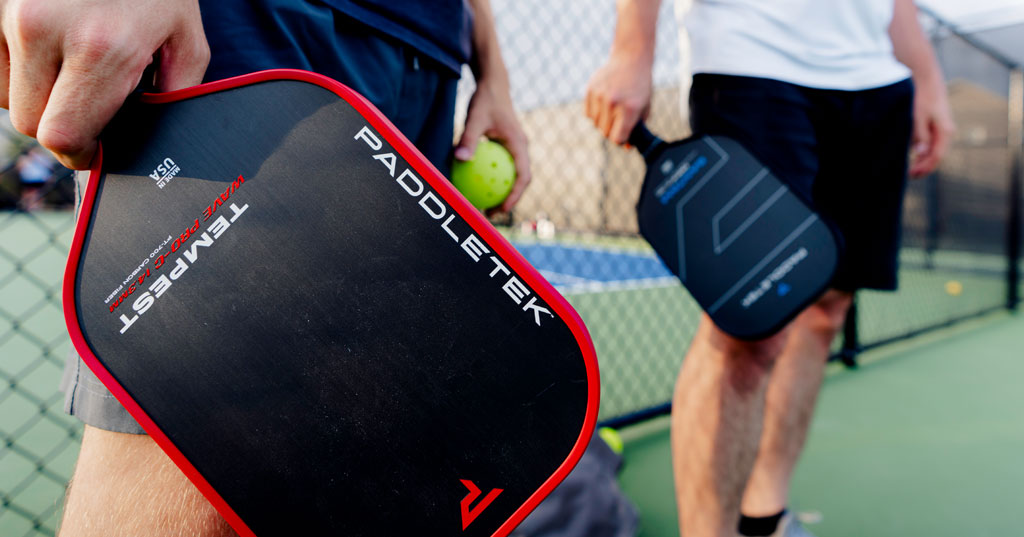
The right pickleball paddle matches your skill level, your playing style, and your body. Start with weight (7.5 to 8.5 oz for most players), then narrow by core thickness (thicker for control, thinner for power), shape (standard for a bigger sweet spot, elongated for reach and spin), and grip size (you should be able to fit one finger between your fingertips and palm). Everything else is refinement. Here is how each variable works and what to look for at every stage of the game.
Why does your paddle choice actually matter?
Pickleball exchanges happen fast. At the kitchen line, the ball travels roughly 14 feet in under 400 milliseconds. You do not get a full backswing. You do not get a second chance to adjust your grip. The paddle in your hand is either helping you manage that speed or it is working against you.
A tennis racket gives you a 100-square-inch string bed and a full second to read a groundstroke. In pickleball, your face is a fraction of that size and your reaction window is a fraction of that time.
The specs of the paddle, its weight, its core, its shape, are not marketing categories. They are physics. They determine how much energy the ball returns, how forgiving the sweet spot feels on off -center contact, and how fast you can get the paddle from your backhand hip to a forehand block.
That is why "just pick one" is bad advice. And that is why the five variables below are worth understanding before you spend a dollar.
The Science Behind Pickleball
Read MoreHow does paddle weight affect your game?
Weight is the first decision because it affects everything else: power, stability, hand speed, and fatigue.
Most pickleball paddles fall between 7.3 and 8.4 oz. That range sounds small. It is not. A half-ounce difference changes how the paddle swings, how fast you can reset at the net, and how your arm feels after two hours of doubles.
Heavier paddles (8.2 oz and above) deliver more power with less effort because the mass does the work. They also resist twisting on off -center hits, which means a more stable feel on blocks and volleys. The Paddletek Bantam GTO-C sits in this range at 7.7 to 8.1 oz, and it is one of the reasons competitive players trust it under pressure.
Lighter paddles (under 7.8 oz) give you faster hand speed at the kitchen line, where quick exchanges reward reaction time over raw power. The tradeoff is that you supply more of the energy yourself, and lighter paddles are less forgiving when you miss the center of the face.
If you are choosing your first serious paddle, start in the middle of the range (7.8 to 8.0 oz) and adjust from there. You can always add lead tape to increase weight. Taking it away is harder.
What does core thickness do?
Core thickness is the variable most players overlook and the one that changes feel the most.
A thicker core (16 mm) keeps the ball on the face longer. Longer dwell time means more control, a softer feel, and a bigger effective sweet spot. If your game lives at the kitchen line, if you rely on dinks, drops, and resets, a thicker core is your friend.
A thinner core (14 mm or less) compresses and rebounds faster. That means more pop, a crisper response, and more power on drives and overheads. It also means a smaller margin for error on touch shots.
The Paddletek Honeyfoam TKO-X uses a 14 mm full-foam core that manages both sides of this equation: the foam dampens harsh vibration while the thinner profile keeps energy transfer fast. The Bantam TKO-C offers a 14.3 mm honeycomb polymer core that gives you that classic Bantam responsiveness with a touch more forgiveness than the 12.7 mm option.
Most players moving up from a starter paddle will feel the biggest immediate difference switching to a quality core, not a different shape, not a different surface. Core is where the feel lives.
See How Paddletek's 12.7 mm and 14.3 mm Cores Differ
Read MoreWhich paddle shape should you choose?
Shape determines two things: reach and sweet spot size. Everything else (weight distribution, handle length, maneuverability) follows from there.
 |
Standard shape (roughly 16" x 8") gives you the widest face and the most forgiving sweet spot. You do not have to be perfectly centered on every contact to get a clean shot. For doubles players and anyone who values consistency over reach, standard is the safer pick. The Paddletek Bantam ESQ-C and the Honeyfoam ESQ are both standard-shaped paddles built for players who prioritize control and sweet spot size. |
 |
Elongated shape (roughly 16.5" x 7.5") narrows the face by about half an inch and stretches the paddle taller. You gain reach (useful for singles, overhead coverage, and two-handed backhands) and a longer handle. The tradeoff is a narrower sweet spot, which demands cleaner contact. The Bantam TKO-C and Honeyfoam TKO-X are both elongated designs. |
 |
Hybrid shape (roughly 16.25" x 7.75") splits the difference. The Bantam GTO-C sits here, offering more reach than a standard with a wider sweet spot than a full elongated. If you cannot decide, this is where to start. |
One thing that matters more than people realize: handle length. If you hit a two-handed backhand, you need at least 5.5 inches of handle. Most elongated paddles deliver this naturally. Check before you buy.
How do you match a paddle to your level?
Your skill level determines which specs matter most right now.
Just starting out. You need forgiveness and comfort, not performance. A mid-weight paddle (7.8 to 8.0 oz) with a standard or hybrid shape and a thicker core will be the most playable. The Paddletek Phoenix Firestorm at $99.99 is built exactly for this: elongated for reach, 14 mm core, and light enough to learn proper mechanics without fighting the weight. The Bantam EX-L Pro at $99.99 takes the standard shape route with a forgiving composite face.
Getting serious (3.0 to 3.5). You are developing a soft game, you recognize the kitchen as the scoring zone, and you want a paddle that rewards clean technique. Core quality and control matter now more than power. This is where the Tempest Wave Pro-C ($149.99) or Bantam GTO-C ($199.99) start making sense. You will feel the difference immediately coming from a starter paddle.
Competing (4.0+). You know what you need. You are choosing between control and power, between thinner cores for pop and thicker cores for touch, between raw carbon faces for spin and composite faces for feel. The Bantam C-series and the Honeyfoam line are where you land. The real question at this level is how you play, not how much you spend.
Paddletek lineup at a glance

| What you need | Paddle | Shape | Core | Weight | Price |
|---|---|---|---|---|---|
| Entry with reach | Phoenix Firestorm | Elongated | 14 mm | 7.9 oz | $99.99 |
| Control, forgiving sweet spot | Bantam EX-L Pro | Standard | Composite | 8.3–8.7 oz | $99.99 |
| All-around, ready to progress | Tempest Wave Pro-C | Standard | 14.3 mm | 7.8–8.2 oz | $149.99 |
| Versatile performance | Bantam GTO-C | Hybrid | 12.7/14.3 mm | 7.7-8.1 oz | $199.99 |
| Reach and power | Bantam TKO-C | Elongated | 12.7/14.3 mm | 7.7–8.1 oz | $199.99 |
| Control, wide face | Bantam ESQ-C | Standard | 12.7 mm | 7.5–7.8 oz | $199.99 |
| Full-foam power | Honeyfoam TKO-X | Elongated | 14 mm foam | 8.0 oz | $249.99 |
| Full-foam control | Honeyfoam ESQ | Standard | 14 mm foam | 8.0 oz | $249.99 |
Frequently Asked Questions:
How do I know what size pickleball paddle I need?
Size comes down to shape and grip. For the face, standard gives you the biggest sweet spot, elongated gives you the most reach. For the grip, wrap your dominant hand around the handle: you should be able to fi t your index finger from the other hand in the gap between your fingertips and your palm. Most adult paddles come in a 4" to 4.25" circumference, which fits the majority of players. If you are between sizes, go smaller and add an overgrip.
What is the best pickleball paddle for beginners?
A mid-weight paddle (7.8 to 8.0 oz) with a forgiving sweet spot and a price that lets you focus on learning, not protecting an investment. The Paddletek Phoenix Firestorm ($99.99) and the Bantam EX-L Pro ($99.99) both fit. Avoid the cheapest paddles on the market; they use wood or low-grade cores that will teach you bad habits by masking what clean contact actually feels like.
What is the difference between a pickleball paddle and a pickleball racket?
Nothing. "Racket" and "paddle" refer to the same piece of equipment. "Paddle" is the standard term in the sport because early paddles were solid (no string bed), but "racket" is common among players coming from tennis. Either word, same thing.
How much should I spend on a pickleball paddle?
For a first serious paddle, $99 to $149 gets you quality materials and construction that will last. At $149 to $199, you are into performance-tier paddles with raw carbon faces, advanced polymer cores, and precision engineering. Above $200, you are paying for the latest core technology (like Paddletek's full-foam Honeyfoam) and the most refined feel available. Buy the best paddle you can afford at your current level, then upgrade when your game demands it, not before.
Does paddle shape affect spin?
Not directly. Spin comes from surface texture (raw carbon fiber generates more friction than composite), swing mechanics, and contact angle. Shape affects reach and sweet spot size, which can change where and how you contact the ball, but the shape itself does not add or subtract spin. If spin is a priority, look at the face material first.
Are Paddletek paddles USA Pickleball approved?
The vast majority of the current Paddletek lineup is USA Pickleball approved and legal for sanctioned tournament play. That said, not every model in the catalog carries approval at all times. For example, the Honeyfoam TKO-X 14mm is approved for professional and amateur UPA competition; however, it exceeds the power threshold required for USAP-sanctioned events. Approval status can shift as testing protocols evolve. Before you register for a tournament, check your exact model against the official USA Pickleball Approved Paddle List at equipment.usapickleball.org. Paddletek publishes recall and compliance updates on their site when changes happen.

Leave a comment
This site is protected by hCaptcha and the hCaptcha Privacy Policy and Terms of Service apply.