
A pickleball paddle core determines how the ball feels when it hits, how much energy comes back, and how consistent that response stays over months of play. Honeycomb polymer (polypropylene in hexagonal cells) has been the standard for decades: predictable, proven, and trusted at every level. Full-foam cores replace that grid with engineered foam, delivering a more uniform feel and addressing durability problems like core crush. Neither is categorically better. They solve different problems. Here is how each one works, what the engineering actually does, and why it matters in a sport where you are making contact decisions faster than a tennis player ever has to.
How to Match a Paddle to Your Game
What does the core actually do inside a paddle?
Talk to someone who thinks pickleball is just a backyard game and they will tell you a paddle is a paddle. Hand them two paddles with different cores and ask them to hit a third-shot drop. They will feel the difference on the first ball. The core is why.
Every modern paddle is a sandwich. Two face sheets (carbon fiber, fiberglass, or a composite blend) bonded to a core material in between. The face sheets provide stiff ness. The core provides shear resistance, energy absorption, and feel. That is the same composite sandwich panel engineering used in aerospace and defense, borrowed because it solves the same problem: maximum performance at minimum weight. Pickleball borrowed it because this sport demands the same precision. You are making 60 to 80 paddle contacts per game at reaction speeds under half a second. The core has to perform on every single one.
When the ball hits, the core does three things simultaneously. It absorbs some of the incoming energy (that is your control over pace). It returns some of that energy to the ball (that is your power). And it resists deformation across the face (that is your sweet spot holding its shape under pressure). Absorb, return, resist. That is the entire performance equation. Everything else, surface texture, edge construction, weight distribution, modifies how the core's work reaches your hand.
How Core Thickness Changes Feel and Power
How does a honeycomb core work?
 Polypropylene honeycomb is a sheet of thermoplastic molded into hexagonal cells. Same geometry as a beehive. Same geometry the aerospace industry has used since the 1940s for structures that need to be light, strong, and reliable under repeated stress. The fact that a pickleball paddle uses the same core engineering as aircraft panels should tell you something about what this sport demands from its equipment. But people still call it a backyard game.
When the ball compresses a honeycomb core, the cell walls flex and absorb energy. Thicker cells (14.3 mm in Paddletek's lineup) flex more, absorb more, and give you a softer, more controlled response. Thinner cells (12.7 mm) flex less, rebound faster, and return more energy as power. That is why core thickness changes feel so dramatically, and why Paddletek offers both options across the Bantam C-series.
The strengths of honeycomb are real and well-documented. It delivers a crisp, transparent feel that serious players rely on for shot feedback. It is predictable. You know what you are getting from the first hit to the thousandth. And polypropylene specifically offers excellent vibration dampening compared to older core materials like aluminum or Nomex.
The vulnerability is also real. Honeycomb cells can crush. Repeated high-speed impacts compress the cell walls over time, creating dead spots where the core no longer rebounds properly. Thermoformed construction, which bonds the paddle layers under extreme heat and pressure, can accelerate this process if manufacturing tolerances are not precise. Core crush was not a significant issue with traditional paddle construction. It became one as the industry pushed toward hotter, more aggressive manufacturing methods in the Gen 3 era.
How does a full-foam core work?
 Full-foam cores replace the honeycomb grid entirely with engineered polymer foam. No cells. No air pockets. No lattice structure to collapse. The foam fills the paddle's interior as a continuous material, which changes the physics of how the core manages energy.
Because foam compresses progressively rather than through discrete cell walls, the response feels different from the first contact. Softer. More cushioned. More uniform across the face. Players describe it as a connected feeling, where the ball seems to sit on the paddle slightly longer before leaving. That perception aligns with what thicker, denser core materials do to dwell time, even if the measurable differences are tiny.
The durability argument for foam is straightforward: without cells, there is nothing to crush. The failure mode that plagues honeycomb cores under aggressive play does not exist in the same way. Foam can still degrade over time (a process sometimes called "pack out," where the material slowly loses its rebound characteristics), but the sudden dead-spot failure that comes from core crush is less likely.
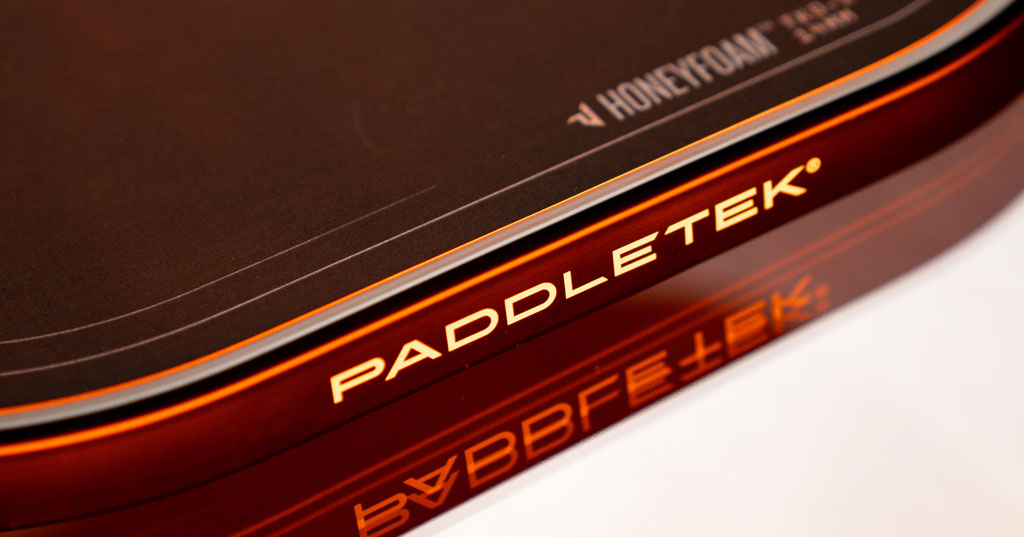
Paddletek's Honeyfoam uses a three-foam architecture. It starts with a low-density EPP core, then wraps that core from the 4 to 8 o'clock positions in high-performance EVA foam to enhance energy return and extend dwell time. A perimeter foam ring completes the system, expanding the sweet spot and adding stability at the edges. It is not simply polypropylene replaced with a single foam slab. Each layer serves a different mechanical purpose, and the result is a paddle that feels softer and more connected than honeycomb while maintaining real power. It launched first in the Reserve as a limited release, was refined through athlete feedback, and now sits in the mainline as Paddletek's Generation 4 collection.
Worth saying plainly: foam is newer. Honeycomb has decades of real-world data behind it. Foam's long-term consistency across brands and price points is still being evaluated. The quality of construction matters more than core type alone, and a well-built honeycomb paddle will outlast and outperform a poorly-built foam one every time.
Full foam vs. honeycomb: the comparison
| Category | Full-foam core | Honeycomb polymer core |
|---|---|---|
| Structure | Engineered foam fills the paddle interior as a continuous material | Polypropylene hexagonal cells form a lattice grid |
| Feel | Softer, more cushioned, uniform across the face | Crisp, direct, highly predictable feedback |
| Energy return | Progressive compression, often described as springier | Scales with swing speed, controlled and consistent |
| Sweet spot | More uniform response edge to edge | Strong center, more dependent on construction quality |
| Durability risk | "Pack out" (gradual loss of rebound) possible over time | Core crush (cell collapse) possible under high-impact play |
| Vibration | Higher dampening, less shock transferred to the arm | Good dampening with PP; better than aluminum or Nomex |
| Track record | Newer technology, still being evaluated long-term | Decades of proven, reliable performance |
| Best for | Players who want a softer feel, arm-friendly dampening, and modern construction | Players who want transparent feedback, proven consistency, and crisp response |

Where does spin come from?
Not from the core. Not primarily, anyway.
Spin in pickleball comes from the same place it comes from in tennis: the interaction between the ball and the striking surface at contact, combined with your swing path and brush angle. The difference is that in tennis, a string bed does half the grabbing for you. In pickleball, a solid face has to create all of its friction through material and texture. That is a harder engineering problem, and it is the reason face material matters so much in this sport.
Raw carbon fiber faces are popular for exactly this reason. Their naturally textured surface generates more friction than smoother composite finishes, making brush-based spin mechanics more effective. You do not need to swing harder. You need the surface to grab.
Dwell time also plays a supporting role. The slightly longer the ball stays in contact with the paddle face, the more opportunity the textured surface has to grip the ball and transfer the brushing motion into rotation. Dwell time alone does not create spin—it simply gives friction and technique a little more time to do their work. That's why paddles that pair a responsive face with a controlled amount of pocketing often feel easier to generate heavy topspin or slice with.
So where does the core fit? Stability. A core that resists twisting on contact keeps the face angle clean through the spin window. If the paddle torques during the milliseconds of ball contact, your brush direction shifts and spin becomes inconsistent. A stable, well-constructed core (foam or honeycomb) also helps provide the controlled dwell time that allows the face texture to stay engaged with the ball while keeping the paddle stable through impact. It does not create spin on its own.
This is why surface plus core is the right way to think about it. Raw carbon for friction. A quality core for stability and controlled dwell time. Your technique for everything else.
The Power vs. Control Tradeoff
Which core is right for your game?
If you already know what you like, trust that. This section is for players choosing between the two for the first time or considering a switch.
Choose honeycomb if you value crisp, transparent feedback and want to feel exactly what the ball does on every contact. If you have played with polymer cores before and liked the direct, predictable response, a well-built honeycomb paddle (like Paddletek's Bantam C-series with QRT construction) will continue to deliver that experience reliably. The Bantam is the most-medaled paddle in the sport for a reason: its honeycomb core gives competitive players the raw information they need.
Choose foam if you want a softer, more cushioned feel, a wider effective sweet spot, or if you are managing arm discomfort from repeated play. Foam's progressive compression and superior vibration dampening make it the more forgiving option for long sessions and for players dealing with tennis elbow or wrist strain. Paddletek's Honeyfoam delivers this through a multi-density foam construction that maintains power (Zane Navratil calls it "a really good all-around paddle, not somebody who's all power, not somebody who's all finesse, but somebody who wants both at the same time").
The honest answer for most players: the core type matters less than the quality of the construction and the fi t to your playing style. A well-built paddle from a manufacturer with real engineering and QC processes will outperform a cheap paddle regardless of what is inside. This is a sport where contact decisions happen in fractions of a second. Your core has to show up for every one of them. Start with how you play, match the specs to your game, and let the core type follow from there.
How Honeyfoam and Bantam Compare Head-to-Head
Frequently asked questions
Is a foam core better than a honeycomb core for pickleball?
Neither is categorically better. Foam cores off er a softer feel, a more uniform sweet spot, and better resistance to core crush. Honeycomb cores deliver crisper feedback, proven long-term consistency, and a familiar response that competitive players rely on. The right choice depends on whether you prioritize feel and forgiveness (foam) or feedback and predictability (honeycomb). Quality of construction matters more than core type alone.
What is core crush in a pickleball paddle?
Core crush is the structural collapse of honeycomb cells inside a paddle. It happens when repeated impact or aggressive manufacturing (particularly thermoforming under high heat and pressure) compresses the cell walls beyond their recovery point. The result is dead spots where the paddle no longer rebounds properly. Core crush was not a significant issue with traditional construction methods but became more common as the industry adopted thermoforming in the Gen 3 era.
Does a raw carbon fiber face add spin?
Raw carbon fiber does not generate spin by itself. It creates a rougher, grittier surface that increases friction between the ball and the face. That friction allows the ball to grip the face longer during brush-based strokes, which translates your swing path into ball rotation more effectively. Spin is a system: surface friction, core stability, swing mechanics, and contact angle all contribute.
What is Paddletek Honeyfoam?
Honeyfoam is Paddletek's full-foam core technology. It uses a three-foam architecture: a low-density EPP core wrapped in high-performance EVA foam (from the 4 to 8 o'clock positions) for energy return and dwell time, completed by a perimeter foam ring for stability and sweet spot expansion. First introduced in the Reserve as a limited release, Honeyfoam was shaped by athlete feedback and now sits in the mainline as Paddletek's Generation 4 collection. Available in the Honeyfoam TKO-X (elongated, 8.0 oz, swing weight 115, twist weight ~6, $249.99) and Honeyfoam ESQ (standard, 8.0 oz, swing weight 108, twist weight 6.3, $249.99). Both come in 14 mm and 16 mm core thickness options.
Will honeycomb cores become obsolete?
Unlikely in the near term. Honeycomb polymer has decades of proven performance and a very large installed base of players who prefer its feel. Foam is a promising technology that solves real problems (particularly core crush), but it is still newer and its long-term consistency across brands and price points is being established. The most technically serious brands, including Paddletek, offer both, which is probably the right answer for the foreseeable future. Read more about the materials science of composite sandwich panels on Pickleball Science.


Leave a comment
This site is protected by hCaptcha and the hCaptcha Privacy Policy and Terms of Service apply.