
How long can you keep a paddle performing? Casual players get years out of a quality paddle. Frequent players, three to five sessions a week, should expect 6 to 18 months of peak performance. Competitive players who hit hard and play daily will burn through a paddle faster than either group. But the gap between those numbers depends almost entirely on how you store, clean, and protect your gear. A paddle endures thousands of impacts over its lifetime. You cannot stop that clock. You can slow it down. Here is how.
Why do paddles wear out in the first place?
Every contact between ball and face sends energy into the core. Over thousands of repetitions, that energy slowly compresses the internal structure, whether it is honeycomb polymer or engineered foam. The core gradually loses its rebound characteristics. Dead spots form. The sweet spot shrinks. That process is normal, unavoidable, and happens to every paddle ever made.
What is not normal is accelerating that process through neglect. Heat, moisture, hard-surface impacts, and careless storage can take months off a paddle's useful life. The difference between a paddle that performs for 18 months and one that fades at 8 is usually not the paddle. It is the player's habits between sessions.
This is equipment built to handle the same reaction-speed demands as a tennis racket, engineered with aerospace-grade composite sandwich construction. It deserves to be treated that way.
How Honeycomb and Foam Cores Differ in Durability
How does heat damage a pickleball paddle?
Heat is the single biggest threat to paddle longevity, and it is the one most players ignore. Leaving a paddle in a hot car on a summer afternoon can push interior temperatures past 140°F. At those temperatures, the adhesive bonding the face sheets to the core begins to soften. The core material itself can deform. Thermoformed paddles, which were built under heat and pressure, are especially sensitive to re-exposure.
The fix is simple and costs nothing. Store your paddle indoors in a temperature-controlled space. Not the garage. Not the trunk. Not leaning against a sunny window. If you play outdoors in heat, bring the paddle inside when you are done. Cold matters too: prolonged freezing temperatures make composite materials more brittle and prone to micro-cracking on impact.
Your paddle survived aerospace-grade engineering. Do not let a parked car undo it.
Does a paddle cover actually help?
A cover will not prevent the internal wear that comes from gameplay. It protects everything else. Scratches, dings, and abrasion during transport and storage degrade the face texture over time. On a raw carbon fiber surface, where that gritty texture is what generates spin, protecting it when the paddle is not in use is protecting your spin game.
Think of it as a case for your phone. You do not expect it to prevent software aging. You expect it to keep the screen from cracking in your bag.
How should you clean a pickleball paddle?
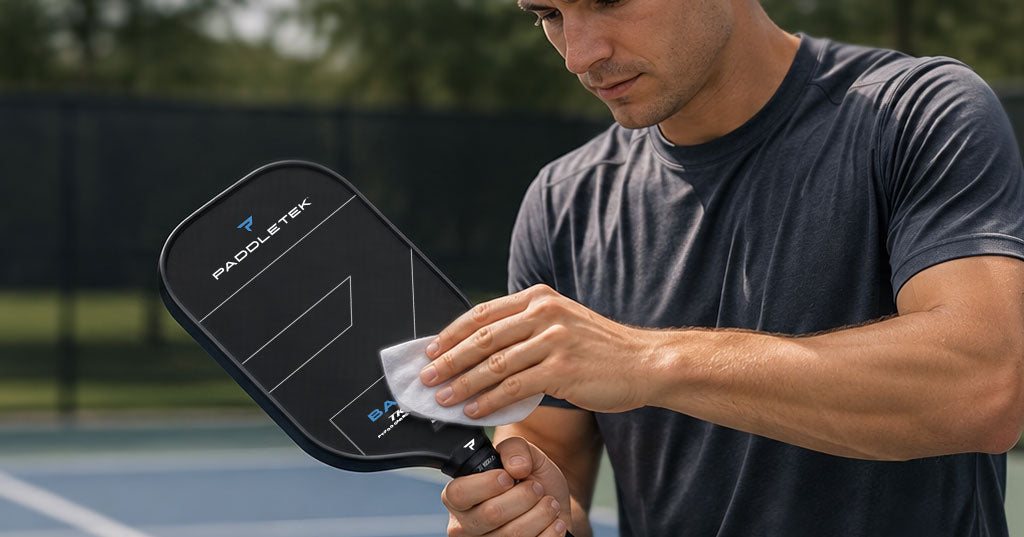
Dirt, ball residue, and court debris accumulate on the face after every session. That buildup reduces the surface friction that gives you grip and spin on the ball. A quick wipe with a microfiber cloth after play keeps the face performing consistently.
For deeper cleaning, Paddletek's RESETTM Spray is designed for this. Spray, wipe, done. If your paddle has a raw carbon fiber face (like the PT-700 surface on the Bantam and Honeyfoam lines), a specialized paddle cleaning block can remove embedded debris without damaging the texture. Do not use household cleaners, solvents, or abrasive scrubbers. They can strip the surface treatment or leave residue that changes how the ball interacts with the face.
 |
Paddletek's Reset SprayRead More |
What kind of damage actually shortens a paddle's life?
 Not all wear is equal. Cosmetic marks from normal play, small scratches on the face, minor scuffs on the edge guard, those are trophies. They do not affect performance.
Structural damage is different. And most of it comes from things other than pickleballs. Scraping the court on low dinks. Tapping paddles forcefully after a point. Dropping the paddle on concrete. Hitting a fence post on a wide swing. Each of those sends shock through the construction in ways it was not designed to absorb. An occasional scrape is part of the game. Making it a habit is making a choice to replace your paddle sooner.
Check your paddle every few weeks. Look for cracks or chips around the edge guard, separation between paddle components, unusual rattling sounds (a sign of internal delamination), areas of excessive face wear, and changes in shape or flatness. Cosmetic wear is expected. Cracks, core damage, warping, delamination, or loose components mean the paddle is no longer performing as designed, and it is time to move on.
Does rotating paddles make a difference?
If you play three or more times a week, rotating between two paddles spreads the cumulative impact across both rather than concentrating thousands of contacts on one. The math is simple: half the impacts per paddle means each one lasts meaningfully longer.
Many competitive players already keep a backup paddle in their bag for emergencies. Using it in a regular rotation is not just insurance. It is maintenance. Your primary paddle stays fresher, and your backup stays broken in and game-ready instead of sitting cold.
How do you get the most out of a quality paddle?
A quality pickleball paddle, one built with precision engineering, real QC, and materials that can handle thousands of high-speed impacts, is designed to perform. Your job is to not get in its way. Store it indoors. Clean the face. Protect the surface in transit. Avoid hitting things that are not pickleballs. Inspect it regularly.
Even with excellent care, every paddle eventually wears down. The core compresses. The face dulls. That is the physics of repeated impact, and no amount of maintenance changes it. The goal is not to make a paddle last forever. It is to make sure you are getting every session of peak performance that the engineering put into it.
How Core Construction Affects Durability
Frequently asked questions
How long does a pickleball paddle last?
It depends on how often and how hard you play. Casual players (once or twice a week) can get years of good performance from a quality paddle. Regular players (three to five sessions a week) should expect 6 to 18 months. Competitive players who play daily and hit with power will see performance decline sooner. Proper storage, cleaning, and care can push those numbers toward the higher end of each range.
Can you fix a dead spot on a pickleball paddle?
No. A dead spot means the core has been structurally compromised in that area, either from core crush (in honeycomb paddles) or material degradation. Once the internal structure fails, it cannot be restored. If you notice a dead spot, it is time to replace the paddle rather than try to repair it.
Should I use a paddle cover?
Yes, especially during transport and storage. A cover protects the face from scratches, dings, and abrasion that degrade surface texture over time. On raw carbon fiber faces, where spin depends on surface grit, a cover directly protects your spin performance. It will not prevent internal wear from gameplay, but it handles everything else.
How do you clean a raw carbon fiber paddle face?
Wipe the face with a microfiber cloth after each session to remove ball residue and court debris. For deeper cleaning, use a product designed for paddle care (like Paddletek's RESETTM Spray) or a specialized paddle cleaning block for embedded debris. Avoid household cleaners, solvents, or abrasive scrubbers, which can damage the surface treatment.
Does leaving a paddle in a hot car damage it?
Yes. Interior car temperatures can exceed 140°F on a hot day, which is enough to soften adhesives, deform core materials, and compromise the bond between face sheets and core. Always store your paddle indoors in a temperature-controlled environment when you are not playing.


Leave a comment
This site is protected by hCaptcha and the hCaptcha Privacy Policy and Terms of Service apply.