
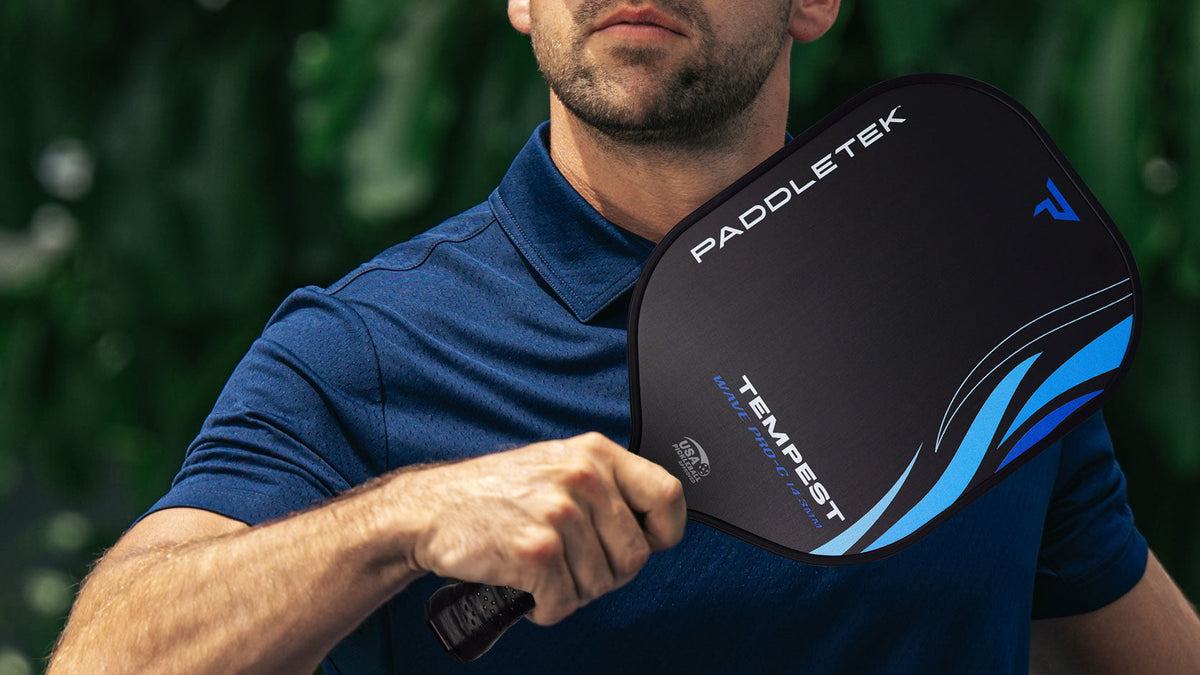
The best paddle for an intermediate pickleball player has a forgiving sweet spot, a control-oriented core (14 mm or thicker), a raw carbon face that generates spin without demanding perfect technique, and a price between $100 and $200 that reflects serious construction without paying for specs you cannot fully use yet. That means a standard-shaped paddle with a quality polymer core. Not the most expensive paddle on the wall. Not the one the pros play with. The one that matches where your game actually is right now, and rewards the technique you are building rather than punishing the technique you have not developed yet. Here is what to look for, what to ignore, and when you are ready to move up.
What does "intermediate" actually mean in paddle terms?
It does not mean you have been playing for a specific number of months. It means your game has changed in ways that make your starter paddle the wrong tool.
You can keep a rally going without thinking about it. You have a third-shot drop, even if it is not consistent. You understand the kitchen as the scoring zone, not just a line you cannot step on. You are starting to recognize patterns: where the ball is going before it gets there, when to speed up, when to reset. You play doubles with intention, not just reaction.
In tennis terms, you have moved past the "just get it over the net" phase into the "I have shots and I want to use them" phase. That transition changes what you need from your equipment. A starter paddle was designed to be forgiving and inexpensive. An intermediate paddle is designed to reward developing technique.
The mistake most players make at this stage is overspending on a pro-level paddle they cannot fully utilize, or underspending on another beginner paddle that will hold them back just like the last one. The sweet spot is in the middle. Both in price and in specs.
What should an intermediate player prioritize?
Four things, ranked by how much they affect your game at this stage.
1. Core thickness: 14 mm or above. You are developing a soft game. You need a core that compresses enough to give you dwell time on dinks and drops, with a sweet spot large enough to forgive the off-center contacts that still happen when your footwork is catching up to your shot selection. A thinner core (12.7 mm) rewards precision you are still building. At the intermediate level, a thicker core helps more than it limits.
One thing the paddle industry will not tell you because it does not sell as well: at the intermediate level, control matters more than power. The points you are losing are almost never because you could not hit hard enough. They are because a reset popped up, a dink floated, or a drive sailed two inches long. Those are control problems. A paddle built around power (thin core, high energy return, maximum pop) amplifies every mistake. A paddle built around control (thicker core, longer dwell time, forgiving sweet spot) gives you room to develop the touch and placement that actually win points at this stage. Power is easy to market. Control is harder to sell and more useful to own.
"Opt for a 16x8 widebody frame for its forgiving sweet spot and higher twist weight, giving you superior control during fast reactions; a real contrast to an elongated paddle that sacrifices sweet spot size to emphasize power, creating a greater chance of mishits."- RayJ Murphy, Director of racquet sports at Paddletek Group
2. Shape: standard or hybrid. Your mechanics are improving but not automatic. A standard shape (16" x 8") gives you the widest sweet spot and the highest twist weight, which means more forgiveness on every contact. A hybrid (16.25" x 7.75") gives you slightly more reach while keeping the sweet spot manageable. Save the elongated shape for when your contact point is consistent enough to handle a narrower face.
3. Face material: raw carbon fiber. This is where intermediate players get the biggest return on their upgrade. A raw carbon face like Paddletek's PT-700 generates meaningfully more spin than the smooth composite or basic fiberglass face on most starter paddles. You do not need to change your stroke to benefit. The surface does work your old paddle could not.
4. Weight: 7.8 to 8.2 oz. Heavy enough to absorb pace on blocks and volleys. Light enough to maintain hand speed at the kitchen line during a two-hour session. This is the range where most intermediate players can sustain play without fatigue or loss of control.
Need Help Choosing A Paddle?
Read our blog How to Choose a Pickleball Paddle
What should you stop paying attention to?
Brand hype and pro endorsements. The paddle Christian Alshon uses is designed for a 6'2" former NCAA tennis champion with tour-level hand speed. It is an incredible paddle. It is not built for your game yet. Buy for your current level, not for the level you hope to reach by association.
Maximum spin ratings. Every paddle claims maximum spin. What matters at the intermediate level is consistent spin: a surface that grips the ball reliably across a range of contact angles, not a surface that peaks on perfect strokes and disappears on rushed ones. Quality raw carbon delivers this. Gimmick coatings do not.
Static weight as the primary spec. Two paddles at 8.0 oz can feel completely different depending on shape, balance, and swing weight. If you are comparing paddles by the number on the box, you are comparing the wrong thing. Read about what swing weight and balance actually do before you fixate on static weight.
The most expensive option. A pro-level Bantam TKO-CX is a brilliant paddle. It is also engineered for players who consistently find the sweet spot on an elongated face and know they want that thinner, crisper 12.7 mm core. At the intermediate level, you are better served by a $149 paddle that teaches you what quality feels like, so that when you do move to a performance paddle, you know exactly what you are paying for and why.
Why is the Tempest Wave Pro-C Paddletek's best-seller?
Because it is built for the player most people actually are, not the player most marketing targets.
The Tempest Wave Pro-C ($149.99) is a standard-shaped paddle (16" x 8") with a 14.3 mm Smart Response Technology polymer core, a PT-700 Unidirectional Raw Carbon Fiber face, and a static weight range of 7.8 to 8.2 oz. That combination gives you control and forgiveness through the core, spin through the face, and a sweet spot wide enough to reward developing technique rather than punish it.
The SRT core is the Tempest line's defining feature. Smart Response Technology provides touch on soft shots (dinks, drops, resets) and power assistance on drives and put-aways. It does not ask you to choose between touch and power the way a thinner core does. At 14.3 mm, it sits in the control-oriented range with enough compression to extend dwell time and enough rebound to keep your drives honest.
The PT-700 raw carbon face is the same Toray 700 carbon fiber used on the Bantam line, including the TKO-CX that Christian Alshon plays on tour. You are not getting a downgraded surface at a lower price point. You are getting the same spin-generating texture that Paddletek's tour players rely on, built on a core that forgives the inconsistencies in your contact that a pro's does not have.
At $149.99, it sits exactly where an intermediate paddle should: above the starter tier where construction quality drops off, and below the performance tier where you are paying for refinements you cannot yet feel. That is not a compromise. That is good engineering aimed at the right player.
The 5.25-inch handle accommodates a standard grip comfortably. If you hit a two-handed backhand, it will feel short. When you are ready to step up, the Bantam TKO-CX ($199.99) with its 5.75-inch handle and elongated shape accommodates that grip naturally.
When are you ready to step up from the Tempest?
When you know what you want from a paddle and can feel the difference between core types, you are ready for the Bantam ESQ-C or the Honeyfoam ESQ. Both are standard-shaped, which means you keep the wide sweet spot and high twist weight that serve intermediate players well. The difference is what is inside.
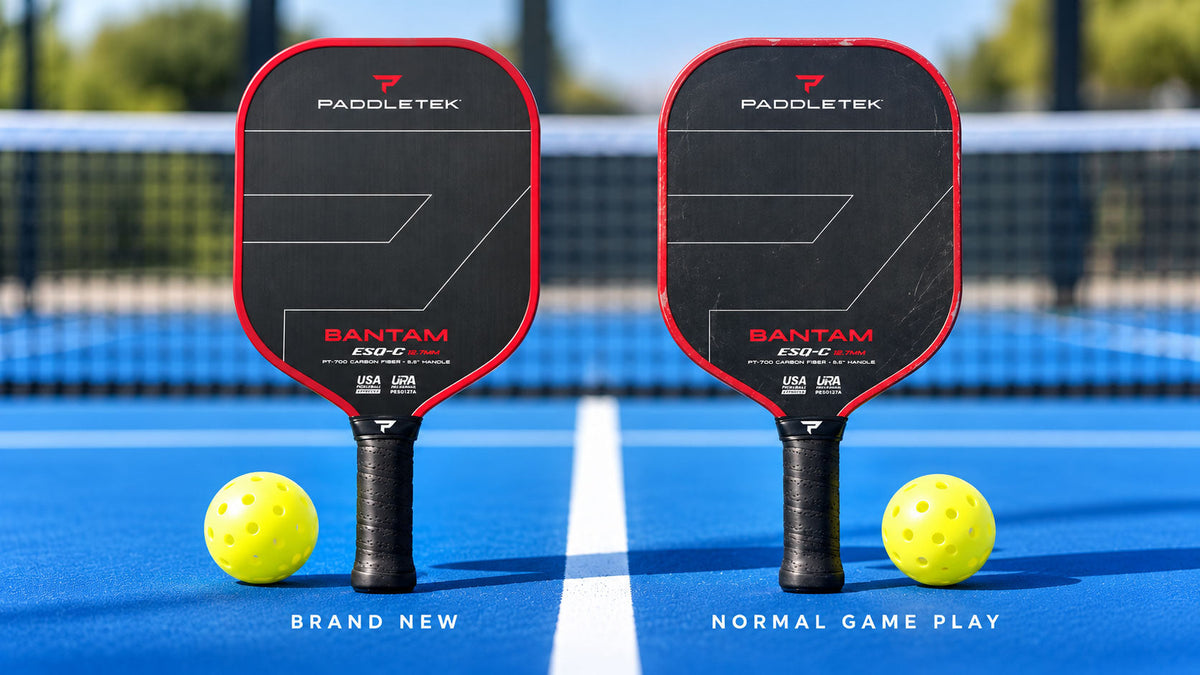
The Bantam ESQ-C ($199.99) uses a 12.7 mm QRT honeycomb polymer core. It gives you crisper, more transparent feedback than the Tempest's SRT core. You feel exactly what the ball does on every contact. It rewards clean technique and tells you when your contact drifts. If you want a paddle that sharpens your game by giving you honest information, this is where to go.
The Honeyfoam ESQ ($249.99) uses a 14 mm multi-density foam core. It gives you a softer, more cushioned feel with superior vibration dampening. The sweet spot feels more uniform edge to edge. If you want a paddle that absorbs harshness and lets you play longer with less strain on your arm, this is the foam path.
Both use the same PT-700 raw carbon face. Both keep the standard shape that gives intermediates room to grow. The choice between them is about feel preference, not performance hierarchy.
When are you ready for a Bantam TKO-CX?
When your contact point is consistent enough that you do not need a wide sweet spot to bail you out. That is the honest answer.
The Bantam TKO-CX is Christian Alshon's signature paddle: elongated (16.5" x 7.5"), 12.7 mm QRT honeycomb polymer core, PT-700 raw carbon face. It is built for reach, leverage, and aggressive play. The elongated shape moves the sweet spot higher on the face and narrows it compared to a standard paddle. That smaller sweet spot rewards players who consistently find center and punishes those who do not.
If your third-shot drop lands in the kitchen seven times out of ten, if your contact on drives is clean and centered more often than not, if you understand what you want from a paddle and can articulate it in terms of feel, shape, and core response, you are ready. The TKO-CX will give you reach, power, and the kind of raw feedback that a touring pro relies on.
If you are still working toward that consistency, a standard-shaped paddle is not a compromise. It is the right shape for where your game is now.
There is also a different path for players who know they want a foam core. Paddletek's Honeyfoam line uses a multi-density foam construction (EPP core wrapped in EVA foam with a perimeter foam ring) instead of the honeycomb polymer found in the Bantam and Tempest. The feel is softer, more cushioned, and more uniform across the face. It is not better or worse than honeycomb. It is a different answer to the same question: how do you want the ball to feel when it hits your paddle? The Honeyfoam ESQ ($249.99) keeps the standard shape, so you get the foam feel without giving up the wide sweet spot that intermediates need. If you have not played with all three, the Tempest, Bantam ESQ-C, and Honeyfoam ESQ will teach you what you prefer before you commit to a core philosophy.
The paddle industry will happily sell you the most expensive option today. Your game will thank you for buying the right one instead.
Paddletek for intermediate players: the options

| Paddle | Shape | Core | Weight | Price | Best for |
|---|---|---|---|---|---|
| Tempest Wave Pro-C | Standard (16" x 8") | 14.3 mm SRT polymer | 7.8-8.2 oz | $149.99 | The intermediate sweet spot: control, spin, forgiveness |
| Phoenix Firestorm | Elongated (16.5" x 7.5") | 14 mm | 7.9 oz | $99.99 | Budget entry with reach, still learning |
| Bantam EX-L Pro | Standard (16" x 8") | Composite | 8.3–8.7 oz | $99.99 | Budget entry, forgiving sweet spot |
| Bantam ESQ-C | Standard (16" x 8") | 12.7 mm QRT polymer | 7.5-7.8 oz | $199.99 | Performance upgrade with a forgiving sweet spot: crisp feedback, standard shape |
| Honeyfoam ESQ | Standard (16" x 8") | 14 mm multi-density foam | 8.0 oz | $249.99 | Foam core with a forgiving sweet spot: softer feel, superior dampening |
| Bantam TKO-CX | Elongated (16.5" x 7.5") | 12.7 mm QRT polymer | 7.7–8.1 oz | $199.99 | Advanced: when your contact is consistent enough for a narrower face |
Learn what paddle weight, swing weight and balance actually mean.
Frequently Asked Questions:
What is the best pickleball paddle for intermediate players?
A standard-shaped paddle with a 14 mm or thicker polymer core, a raw carbon fiber face, and a weight between 7.8 and 8.2 oz. The Paddletek Tempest Wave Pro-C ($149.99) fits this description with its 14.3 mm SRT core and PT-700 raw carbon face. It is Paddletek's best-selling paddle because it balances control, spin, and forgiveness at a price that matches the intermediate level.
How much should I spend on a pickleball paddle?
For an intermediate player, $100 to $200 covers the range where construction quality is real and the specs match your level. Below $100, you are often getting starter-tier cores and faces. Above $200, you are paying for performance refinements (like Honeyfoam's multi-density foam core) that intermediate players may not yet be able to feel or utilize. Buy the best paddle for where your game is now.
When should I upgrade from a beginner paddle?
When you can sustain rallies, execute a third-shot drop (even inconsistently), and recognize the kitchen as the scoring zone. At that point, a starter paddle's limitations start holding back the technique you are developing. The most common signs: you are swinging harder for the same results, your spin feels flat, and the paddle feels less responsive than it used to. It may also just be worn out.
Is it worth buying a pro-level paddle as an intermediate?
Not usually. A performance paddle like the Bantam TKO-CX is tuned for players with consistent mechanics, precise contact, and a clear preference for specific feel and shape. Its elongated face and 12.7 mm core reward players who consistently find the sweet spot. At the intermediate level, a mid-tier paddle like the Tempest teaches you what quality construction feels like across the board, which makes your next upgrade an informed decision rather than a guess.
What is the difference between the Tempest, the Bantam, and the Honeyfoam?
Three different core philosophies at three price points. The Tempest uses Smart Response Technology (SRT), a polymer core designed for touch and forgiveness with power assistance on harder shots. It is the most forgiving of the three and sits at $149.99. The Bantam uses QRT (Quick Response Technology), a honeycomb polymer core designed for crisper feedback and more direct energy transfer. It rewards players who consistently find center and sits at $199.99. The Honeyfoam uses a multi-density foam construction (EPP core, EVA foam wrap, perimeter foam ring) that delivers a softer, more cushioned feel with superior vibration dampening. It sits at $249.99. All three use the PT-700 raw carbon face. The Tempest is the right paddle for building your game. The Bantam is the right paddle when your game is built. The Honeyfoam is the right paddle when you know you want foam's feel.

Leave a comment
This site is protected by hCaptcha and the hCaptcha Privacy Policy and Terms of Service apply.