
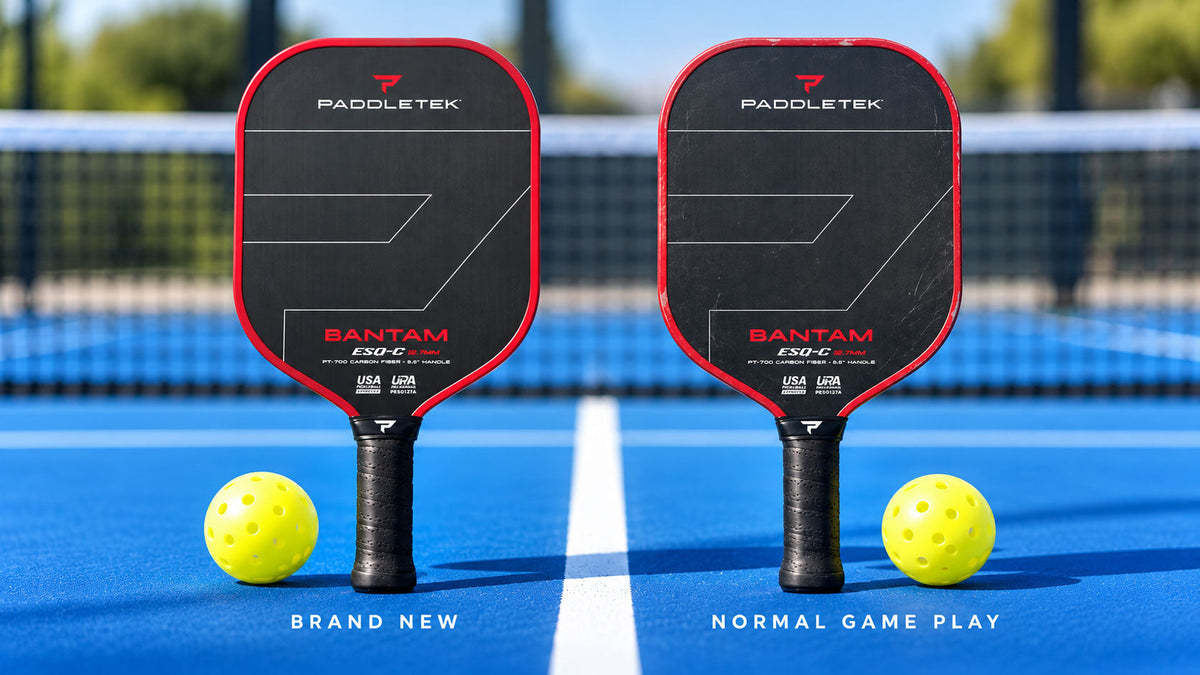
How long does a pickleball paddle last? Casual players can get several years from a quality paddle. Frequent players (three to five sessions a week) should expect to replace every 6 to 18 months. Competitive players who hit hard and play daily may cycle through paddles even faster. But the real question is not how old your paddle is. It is whether the paddle still performs the way it did when you bought it. Most paddles do not break. They fade. Here are the five signs that yours already has.
Why does a paddle stop performing before it breaks?
Because the damage that matters most happens inside, where you cannot see it.
Every contact between ball and face sends energy into the core. Over thousands of repetitions, that energy gradually compresses the internal structure, whether honeycomb polymer cells or engineered foam. The core loses its rebound characteristics one shot at a time. Dead spots form. The sweet spot shrinks. Energy return drops. This is the same kind of material fatigue that degrades a tennis racket's string bed over time, except in pickleball there is no easy restring. When the core goes, the paddle goes.
The result is a decline so gradual you might not notice it for weeks. You blame your game. You blame your mechanics. You adjust your swing. Meanwhile, the paddle is quietly giving you less with every session. Understanding what to look for is the difference between playing through diminished performance and recognizing when your equipment is holding you back.
Is your paddle losing spin?
Spin is usually the first thing to go, and it goes from the outside in.
Modern paddle faces are textured at the microscopic level to grip the ball and generate friction. On a raw carbon fiber surface like Paddletek's PT-700, that texture is the carbon weave itself. On other surfaces, it may be a peel-ply imprint or an applied grit coating. Either way, thousands of ball impacts gradually smooth out those micro-ridges. The face that once grabbed the ball and made it bite now lets it slide.
You will notice it before you can explain it. Serves that used to kick are landing flatter. Topspin drives are not dipping as aggressively. Slice shots feel like suggestions instead of weapons. You are swinging harder for the same result.
Run your thumb across the face. If it feels noticeably smoother than when you bought the paddle, surface wear is real and it is affecting your game.
Learn How Surface Texture Creates Spin
Has the power disappeared?
If shots that once came easily now demand more effort, the core is telling you something.
A healthy core compresses and rebounds predictably on every contact. As the internal structure degrades from repeated impacts, that rebound weakens. The paddle returns less energy to the ball. Drives fall short. Put-away shots lack their usual pace. The paddle feels "dead" at contact, like hitting into a mattress instead of a trampoline.
Many players initially blame themselves for this. They assume they are in a slump or their mechanics have drifted. Sometimes that is true. But if the loss of power came on gradually over weeks rather than appearing overnight after a bad practice, the paddle is the more likely culprit. A slump changes your timing. A worn core changes the physics.
Does the paddle sound different?
Serious players hear their equipment. A paddle that once produced a crisp, consistent pop may start sounding duller, hollower, or inconsistent across the face. Sound is vibration, and vibration is a direct readout of the core's structural integrity.
A change in sound alone does not mean your paddle is done. But combined with any of the other signs on this list, it is confirmation that the internal structure has shifted. Trust your ears. They are more sensitive to core degradation than your hands.
Learn How Honeycomb and Foam Cores Degrade Differently
Are mishits more punishing than they used to be?
When a paddle is performing at its designed level, off-center contact is manageable. The core absorbs the impact, the twist weight holds the face steady, and the ball goes somewhere useful even when you do not catch it cleanly.
As wear accumulates, that forgiveness narrows. You feel more vibration on impact. The face torques more on mishits. Touch shots that used to feel soft and predictable now feel harsh and uncertain. The sweet spot has not moved. It has shrunk.
If you are an experienced player and your confidence in your touch game has dropped without any obvious change in your mechanics, the paddle's forgiveness may have degraded.
That is not a mental problem. That is a materials problem.
What visible damage means the paddle is done?

Not all visible wear matters. Cosmetic scuffs on the edge guard, minor scratches on the face, small paint chips: these are trophies from playing. They do not affect performance.
Structural damage is a different conversation. If you see cracks in the face or edge guard, delamination (separation between the face sheet and the core), significant dents or warping, loose edge guards, or any change in the paddle's flatness, the paddle is no longer performing as designed. Continued play risks making the damage worse and potentially creating an unsafe condition.
Replace it. No amount of sentiment is worth playing with compromised equipment.
How do you test whether your paddle is still performing?
The most reliable test is the simplest one. Borrow a newer version of the same model (or any paddle with similar specs) and play a few points side by side. Hit the same shots. Pay attention to power, spin, feel, stability, and sound.
If the newer paddle feels noticeably more responsive, if your serves kick harder, if your drives carry deeper, if the sweet spot feels bigger, then your current paddle has been gradually fading and you did not notice because the decline happened one session at a time.
Many players are genuinely surprised by how much performance they have lost without realizing it. That surprise is the best argument for testing periodically rather than waiting until the paddle feels obviously dead.
When you are ready to choose what comes next, here is the complete buying guide:
How to Choose a Pickleball Paddle
And if you want to make the next paddle last longer than this one did:
How to Extend the Life of Your Pickleball Paddle
Frequently Asked Questions:
How long does a pickleball paddle last?
It depends on how often and how hard you play. Casual players (once or twice a week) can get several years from a quality paddle. Regular players (three to five sessions a week) typically replace every 6 to 18 months. Competitive players who play daily and hit aggressively may replace even sooner. Proper storage, cleaning, and care extend the upper end of each range.
Can you fix a dead pickleball paddle?
No. Once the core has lost its rebound characteristics or developed dead spots, the internal structure cannot be restored. Surface wear (loss of texture) is also irreversible. A cleaning block or paddle cleaner can remove debris and maintain existing texture, but it cannot rebuild texture that has been worn away by impact. When performance drops, replacement is the only fix.
How do I know if my paddle has dead spots?
Bounce a ball off different areas of the face and listen for changes in sound and rebound height. A healthy paddle produces a consistent bounce and sound across the central portion of the face. A paddle with dead spots will return noticeably less energy in certain areas, and the sound may shift from crisp to dull. You can also feel dead spots during play as areas where the ball seems to die on contact.
Should I replace my paddle if it's cracked?
Yes. Cracks in the face or edge guard indicate structural compromise. Playing with a cracked paddle risks further delamination, inconsistent performance, and potential injury. Even small cracks can propagate under repeated impact. If you see a crack, the paddle is done.
Does the type of paddle affect how long it lasts?
Construction quality matters significantly. Paddles built with precision engineering and quality materials (properly bonded face sheets, consistent core density, reinforced edge guards) tend to hold their performance characteristics longer than budget paddles with looser manufacturing tolerances. Core type also plays a role: honeycomb polymer cores can develop dead spots from cell crush, while foam cores may gradually "pack out" and lose rebound over time. Both degrade eventually. Quality construction slows the process.

Leave a comment
This site is protected by hCaptcha and the hCaptcha Privacy Policy and Terms of Service apply.