
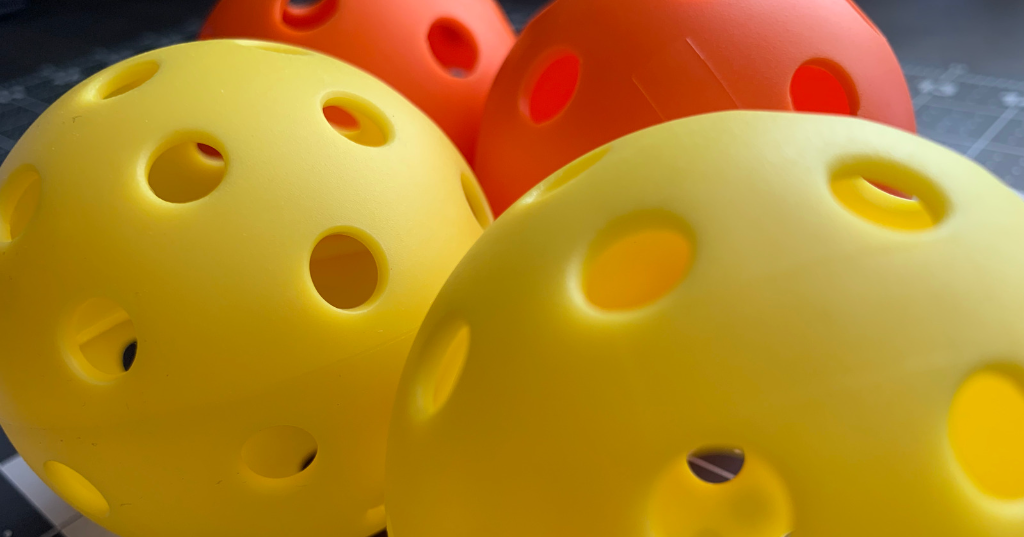
The biggest difference between indoor and outdoor pickleball is the ball. But here is what most guides get wrong: the choice is about court surface, not whether there is a roof overhead. Indoor balls were designed for smooth floors. Outdoor balls were designed for rough courts. Many indoor facilities now use the same hard court surfaces found outdoors, which means you use an outdoor ball even though you are playing inside. The names are misleading. The surface tells you which ball to grab. Once you understand that, the rest of the indoor/outdoor conversation gets simple fast. Here is what actually changes, what stays the same, and how to adjust your game without overthinking it.
What is different between indoor and outdoor pickleballs?
Five things, all traceable to the same engineering problem: making a ball that weighs less than an ounce perform reliably in two completely different environments. Tennis solved this by using the same ball everywhere. Pickleball could not, because a sub-ounce perforated sphere behaves fundamentally differently on a smooth gym floor than on rough concrete in a crosswind. So the sport built two balls. Here is what separates them.
Holes. Indoor balls have 26 holes averaging roughly 0.43 inches in diameter. Outdoor balls have 40 holes averaging roughly 0.28 inches. That 40% difference in hole size is not cosmetic. Fewer, larger holes let more air pass through, which slows the ball and makes it lighter in flight. More, smaller holes reduce air disruption, which helps the ball cut through wind and fly straighter outdoors.

Plastic. Outdoor balls are made from harder, thicker plastic to survive rough surfaces like concrete and asphalt. Indoor balls use softer plastic designed for smooth gym floors and sport court. You can feel the difference immediately: tap an outdoor ball on a table and it clicks. Tap an indoor ball and it thuds.
Weight. Both fall within the USA Pickleball range of 0.78 to 0.935 ounces, but outdoor balls tend to sit at the heavier end (0.9 oz) and indoor balls at the lighter end (0.8 oz). A tenth of an ounce sounds trivial. Over a hundred contacts in a match, you feel the cumulative difference in pace and how the ball comes off your paddle.

Bounce. Outdoor balls bounce lower and faster off hard surfaces. Indoor balls bounce higher and slower off smooth floors. The difference is enough to change your timing on returns and your positioning on third-shot drops.
Durability. Outdoor balls crack. The harder plastic that survives wind and rough courts is also more brittle under repeated impact. Indoor balls deform before they crack, which means they lose their shape gradually rather than splitting mid-rally. Expect to go through outdoor balls significantly faster than indoor balls, especially in competitive play.
Indoor vs. outdoor pickleballs: the comparison
| Category | Indoor Ball | Outdoor Ball |
|---|---|---|
| Holes | 26, larger (~0.43") | 40, smaller (~0.28") |
| Plastic | Softer, more flexible | Harder, more rigid |
| Weight | ~0.8 oz (lighter end of range) | ~0.9 oz (heavier end of range) |
| Bounce | Higher on smooth surfaces | Lower, faster on rough surfaces |
| Speed in flight | Slower, more affected by air | Faster, cuts through wind |
| Spin response | More responsive to spin, softer feel | Less spin grab, crisper contact |
| Durability | Deforms over time, rarely cracks | Cracks under impact, replaced more often |
| Noise | Quieter | Louder (harder plastic, harder surfaces) |
Check out USA Pickleball's approved ball specifications (Section 2.D)
or see the USA Pickleball's approved ball list.
How does the court surface change your game?

This is where most players get the ball choice wrong. And where the names "indoor" and "outdoor" start causing real problems.
The labels suggest a simple rule: playing inside, grab an indoor ball; playing outside, grab an outdoor ball. That rule worked ten years ago when indoor pickleball meant a gymnasium with a hardwood floor. It does not work now. Most dedicated pickleball facilities built in the last few years use the same textured hard court surfaces found outdoors, whether those courts sit under a roof or under the sun. If you are playing on that kind of surface with an indoor ball, you are using the wrong ball. The softer plastic skips and skids on textured courts. The bounce is unpredictable. Your game suffers, and it is not your fault. It is the ball's.
Indoor balls were designed for smooth surfaces: hardwood gym floors, linoleum, rubber, and sport court. The softer plastic grips these surfaces on contact and produces a predictable, higher bounce. Outdoor balls skip and skid on smooth floors because the harder plastic does not grab the same way.
Outdoor balls were designed for rougher surfaces: concrete, asphalt, and coated hard courts. The harder plastic survives the abrasion and produces a consistent, lower bounce on textured surfaces. Indoor balls on rough concrete wear out fast and bounce unpredictably.
Here is the part that trips people up: most indoor pickleball facilities built in the last few years use the same hard court surfaces found outdoors. Dedicated pickleball centers, converted retail spaces, and multi-sport complexes often install textured sport surfacing that plays like an outdoor court. If you are playing on that kind of surface, you use an outdoor ball even though you are standing under a roof. The surface tells you which ball to use, not the ceiling.
When the surface is genuinely smooth (a gymnasium floor, a community center with linoleum, or a classic sport court installation), indoor balls are the right choice. The softer plastic grips the smooth surface properly and gives you the higher, slower bounce that makes indoor rallies distinctive.
The practical adjustment between surfaces is simple: on rougher surfaces (indoor or outdoor), give yourself more margin. Stand slightly farther back on returns. Aim your drops with more clearance over the net. Accept that the ball will occasionally bounce unpredictably on uneven patches and build that into your shot selection. On smooth surfaces, your precision can stay tight because the bounce rewards it.
How Paddle Surface Texture Interacts with Different Ball Types
Does wind actually affect how you play?
Yes, and it is the single biggest variable between the two environments. Not the ball. Not the surface. Wind.
A 10 mph crosswind does things to a pickleball that a tennis ball shrugs off. A pickleball weighs less than an ounce and has 40 holes punched through it. It is, by design, affected by air. Outdoor balls are engineered to minimize this (smaller holes, heavier weight), but they cannot eliminate it.
Wind changes three things. First, your serve. A crosswind pushes the ball laterally during its arc, which means your target shifts. Serving into the wind keeps the ball lower and faster. Serving with the wind makes it sail. Second, your lob game. A lob that lands perfectly on a calm day floats five feet long in a tailwind. Lobs into the wind die short. Third, your dink exchanges. Crosswinds at the kitchen line can push a perfectly aimed dink two inches sideways, which is enough to change whether it lands in or out of the kitchen.
The adjustment is tactical, not technical. Play into the wind more aggressively (the wind slows your ball, so add pace). Play with the wind more conservatively (the wind accelerates your ball, so take pace off). Switch your approach every time you switch sides. This is something tennis players understand instinctively. In pickleball, where the ball weighs a third of a tennis ball, the effect is amplified.
How Dwell Time and Core Thickness Affect Touch and Control
Do you need a different paddle for indoor vs. outdoor?
No. Your paddle works in both environments. The same core, face, and construction that perform indoors perform outdoors.
That said, some players notice subtle differences in how their paddle feels between the two settings. A harder outdoor ball comes off the face faster and with less dwell time than a softer indoor ball. If your game relies on touch and control, you may notice your drops and dinks feel slightly less forgiving outdoors. A thicker core (14 mm or above) helps here because it absorbs more of the harder ball's impact energy.
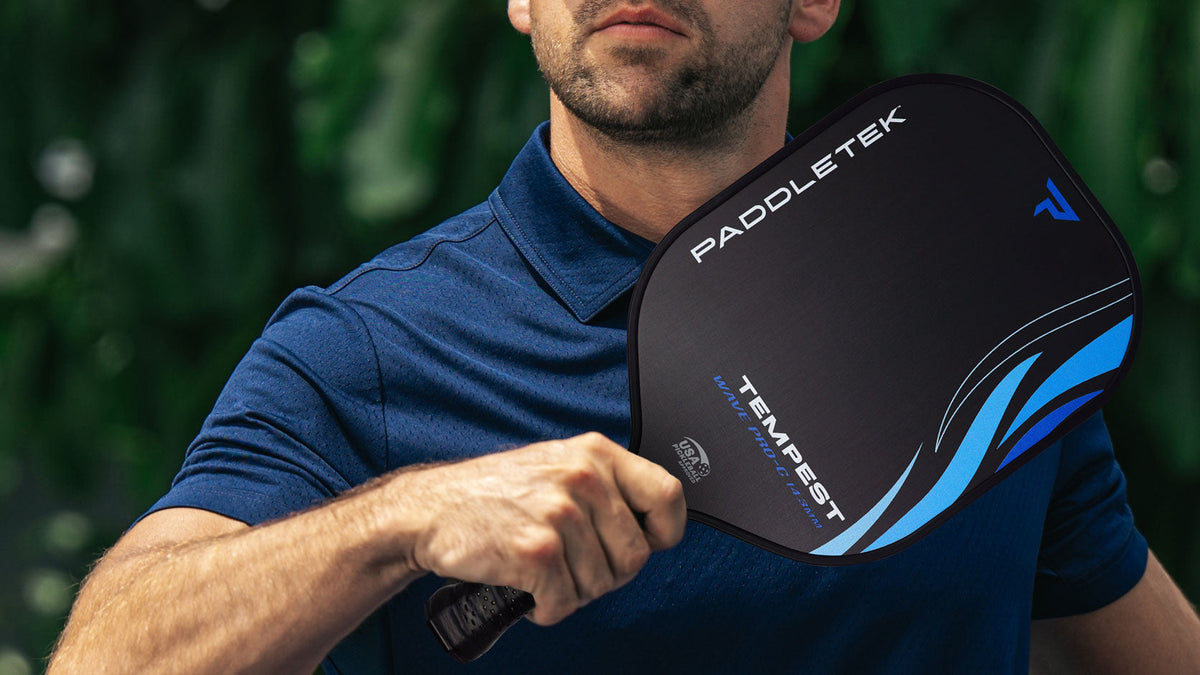
The spin equation shifts slightly too. Indoor balls, with their softer plastic and larger holes, tend to grab the paddle face more readily. Outdoor balls, being harder and smoother, require a bit more brush speed to generate the same rotation. If your paddle has a raw carbon fiber face (like Paddletek's PT-700 surface), the texture provides enough friction to work effectively in both environments. On a smoother composite face, the difference between indoor and outdoor spin may be more noticeable.
The honest advice: play with one paddle in both settings. Learn how the ball behaves differently and adjust your touch rather than switching equipment. The players who perform well in both environments are not the ones with two paddles. They are the ones who read the conditions and adapt.
Why a Thicker Core Helps Absorb Harder Ball Impacts
See Our Full Paddle Lineup
What stays the same no matter where you play?
More than what changes. And that is the point.
The court is 20 by 44 feet. The net is 36 inches at the sidelines and 34 inches at the center. The kitchen is 7 feet from the net on both sides. The serve is underhand. The scoring is the same. Every rule in the USA Pickleball rulebook applies identically whether you are playing in a gymnasium, a converted warehouse, or a public park in July.
Your paddle is the same. Your technique is the same. Your strategy is the same: get to the kitchen, control the pace, win the point. The ball changes. The surface changes. The wind shows up or it does not. Everything else is pickleball.
What makes this worth knowing is what it says about the sport itself. Tennis uses the same ball indoors and out. Pickleball engineered two different balls because the physics of a sub-ounce perforated sphere demanded it. That level of equipment specificity does not happen in a simple game. It happens in a sport that takes its engineering seriously.
How to Protect Your paddle Across Environments
Frequently Asked Questions:
Can you use indoor pickleballs outdoors?
You can, but performance will suffer. Indoor balls are lighter and softer, which means wind will push them off course and rough outdoor surfaces will chew through the softer plastic faster. For casual play on a calm day, an indoor ball works outdoors in a pinch. For anything competitive or in any wind, use the right ball for the environment.
Can you use outdoor pickleballs indoors?
Yes, and many players do. Outdoor balls are harder and faster, which changes the pace and feel of indoor play. They bounce lower on smooth surfaces and produce a crisper, louder contact. Some leagues and facilities specify which ball type to use, so check before you show up.
Why do outdoor pickleballs crack?
The harder plastic that makes outdoor balls durable against rough surfaces is also more brittle. Repeated impacts from paddles and court contact stress the material until it fractures. Temperature plays a role too: cold weather makes the plastic more rigid and crack-prone, while heat can soften it. Expect to replace outdoor balls more frequently than indoor balls, especially in competitive play.
Do indoor and outdoor pickleball courts have different dimensions?
No. The court is 20 feet wide and 44 feet long in both environments. The net height is 36 inches at the sidelines and 34 inches at the center. The kitchen (non-volley zone) extends 7 feet from the net on each side. All dimensions and rules are identical regardless of where you play.
Is indoor or outdoor pickleball better for beginners?
Playing on a smooth surface with an indoor ball is generally more forgiving for beginners. The slower ball, predictable bounce, and absence of wind create a more controlled learning environment. You can focus on technique, footwork, and shot placement without environmental variables complicating the feedback. Once your fundamentals are solid, playing on rougher surfaces with an outdoor ball adds a layer of tactical adaptation that makes your game more complete. Note that many indoor facilities use hard court surfaces that play like outdoor courts, so check the surface, not just whether you are inside.

Leave a comment
This site is protected by hCaptcha and the hCaptcha Privacy Policy and Terms of Service apply.