
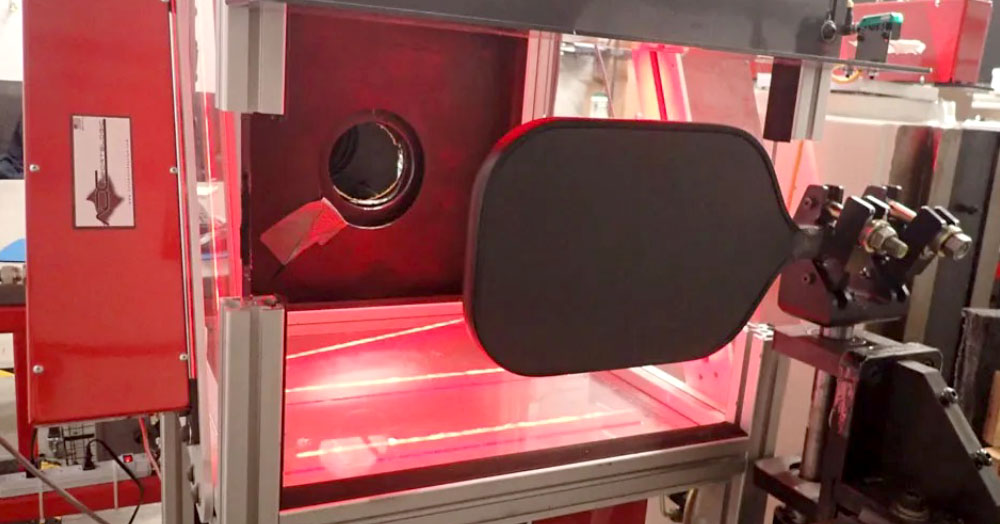
Before your paddle is legal for a sanctioned tournament, it gets fired at by an air cannon, tracked by high-speed cameras from Sweden, and evaluated in the same aerospace defense lab that tests military components. The testing measures power, spin, dimensions, and surface characteristics against strict performance limits. Approval is not permanent: paddles can be pulled from the approved list if the retail product drifts from the certified design. Here is what actually happens behind the scenes, why it matters, and what you should check before your next tournament.
Why does paddle testing exist?
Because equipment was starting to play the points instead of the players.
In late 2023 and into 2024, paddles showed up on the market with power profiles the sport had never seen. Some created what testers called a "trampoline effect," where the face flexed and snapped back like a drumhead, amplifying ball speed beyond what the player's swing produced. Other paddles pushed spin rates so high that returns became nearly impossible to read. The competitive balance of the sport was shifting from skill to gear. USA Pickleball responded by accelerating new tests and decertifying paddles that crossed the line.
That is why the testing exists. Not bureaucracy for its own sake. Protection for a sport where points are decided in tenths of a second, where the margin between a clean winner and a returnable ball is measured in miles per hour, and where a paddle that manufactures its own advantage undermines the entire competitive premise. The testing infrastructure reflects what the sport demands.
What gets tested?
Five categories. Each one addresses a specific way a paddle can gain an unfair advantage or fall outside the boundaries the sport has set.
| What's Tested | How it Works | The Limit | Why it Matters |
|---|---|---|---|
| Power (PBCoR) | Air cannon fires a ball at 60 MPH into the paddle. Inbound and outbound ball speeds determine the coefficient of restitution. | PBCoR ≤ 0.43 | Prevents paddles from returning dangerous levels of power that shift outcomes from skill to equipment |
| Spin (new Oct 2026) | Ball fired at 40 MPH into paddle clamped at 30 degrees. Dual-camera system tracks ball rotation at ~1,500 fps. | ≤ 2,100 RPM | Replaces surface roughness proxy with a direct measurement of what the paddle actually does to the ball |
| Surface Characteristics | 3D optical profiling measures roughness and coefficient of friction. | Measurements of record (RPM becomes the pass/fail gate) | Ensures surface texture stays within tested parameters |
| Dimensions | Precision instruments verify length, width, and combined measurements. | Max 17" length; length + width ≤ 24" | Keeps the playing field geometrically level |
| Weight and Construction | Verified against manufacturer's submitted specifications and material attestations. | Must match certified sample | Ensures the paddle you buy matches the paddle that passed |
The testing happens at Element U.S. Space & Defense, an independent lab. The high-speed camera system is called PaddleVision, built by Image Systems in Sweden. The spin test uses a specially marked ball developed with Franklin Sports so the tracking software can calculate rotation precisely. Over 5,000 paddles and 400 balls have been tested since 2016.
Air cannons. Aerospace labs. Swedish camera systems. Precision-marked test balls. That is the infrastructure behind competitive pickleball equipment regulation.
How Core Construction Affects Power and Performance
What is changing with the new spin test?
The single biggest shift in how paddles get evaluated: measuring what the paddle does instead of what it looks like.
Until October 2026, spin was regulated indirectly. USA Pickleball measured surface roughness and friction, then inferred spin potential from those numbers. Reasonable logic, imperfect results. Two surfaces with similar roughness can produce different spin rates depending on texture geometry, face stiffness, and how the ball deforms on contact.
The new approach fires a ball at the paddle and measures the actual rotation afterward. Direct output. No inference. A paddle that produces more than 2,100 RPM fails regardless of how its surface feels to your thumb.
| Old approach (through Sep 2026) |
New approach (from Oct 2026) |
|---|---|
| Measures surface roughness and coefficient of friction | Measures actual ball RPM after impact |
| Indirect proxy for spin potential | Direct measurement of spin output |
| Two paddles with similar roughness could produce different spin | Same test, same ball, same result for every paddle |
| Surface texture was the primary engineering lever | Core, face, and construction all contribute to the measured output |
What this means for the market: the texture arms race slows down. Manufacturers who competed on who could build the roughest legal surface now face a performance ceiling measured in outcomes, not inputs. Engineering effort shifts toward core construction, dwell time, and overall paddle design. That is a better incentive structure for the sport.
Existing approved paddles remain governed by the standards in effect when they were certified. No retroactive requirement. Your current paddle is fine.
How Paddle Surface Texture and Core Stability Create Spin
Do you need USA Pickleball approval or UPA-A approval?

Depends on where you compete. The sport has two separate certification systems, which creates real confusion. Here is the simple version.
| Where you play | What you need | Who governs it |
|---|---|---|
| Recreational or open play | Usually nothing; use whatever the venue allows | Facility or organizer |
| USA Pickleball sanctioned amateur events | USA Pickleball Approved Paddle List | USA Pickleball |
| PPA Tour, MLP, PPA qualifiers, Challenger Series (pro divisions) | UPA-A certification | UPA-A |
| Amateur brackets at PPA events | Either USA Pickleball or UPA-A | Event-specific |
The two systems test similar things with different methods and thresholds. UPA-A uses a deflection force test and a 2,200 RPM spin cap. USA Pickleball uses PBCoR and (starting October 2026) a 2,100 RPM spin cap. A paddle can pass one and fail the other. Some carry dual certification. Others are approved by one system only.
If you play amateur sanctioned events and never enter a pro bracket, USA Pickleball approval is what you need. Check the list, not the sticker on the paddle.
Why do paddles get removed from the approved list?
Three reasons. All of them can happen after you have already bought the paddle.
The retail product changed. If a manufacturer adjusts materials, construction, or the production process without resubmitting, the paddle you buy may not match the paddle that passed testing. USA Pickleball buys market samples, tests them, and decertifies when deviations appear.
The paddle's performance changed with use. Some paddles get more powerful or generate more spin after being played with. "Break-in" behavior is specifically cited as grounds for decertification. A paddle that passes when new but exceeds limits after a hundred hours is not compliant.
Testing standards evolved. When new tests are introduced, existing paddles may be re-evaluated against updated thresholds. Products that met old standards but exceed new ones face a sunset period (typically 18 months) before decertification takes effect.
The approval list at equipment.usapickleball.org is the live, definitive source. Check it before your next tournament, not just when you buy. Retailer descriptions and product packaging can lag behind changes by weeks or months.
How to Maintain Your Paddle's Performance
When Paddle Performance Changes Over Time and When to Replace It
What are the known issues with the current system?
The testing is necessary. The execution has real problems that affect every stakeholder in the sport.
| Who is affected | What the issues are |
|---|---|
| Players and buyers | Confusion over which approval (USAP vs UPA-A) they actually need. A paddle that was approved at purchase can be decertified later, leaving buyers holding equipment they can no longer use in competition. Product labels and retailer listings lag behind the live approved list, sometimes by weeks. Older approved paddles may be governed by different standards than newer ones, creating an uneven playing field. |
| Manufacturers | Two separate certification systems mean two submission processes, two sets of fees, and two timelines. UPA-A alone costs $10,000 per brand per year plus $3,000 per paddle model for 24-month approval. A brand with six performance variants faces at least $28,000 in published certification fees before rush charges or rework. Standard turnaround is up to eight weeks, which can misalign with product launch cycles. Small and emerging brands bear a disproportionate burden. |
| The sport's governing bodies | Building technically defensible tests that keep pace with rapid equipment innovation is genuinely hard. Enforcing compliance at events requires pre-match paddle testing, dedicated equipment, and trained officials, all of which add time and logistical friction. Transitioning from old standards to new ones (like the surface roughness to RPM shift) creates grandfathering questions where older paddles play by different rules than newer ones. |
Two structural tensions sit underneath all of these issues.
The first is that two regulatory systems create unnecessary complexity. USA Pickleball governs the amateur pathway. UPA-A governs the professional pathway. Both are moving toward direct output measurement (spin RPM), but their thresholds differ (2,100 vs 2,200 RPM), their power tests differ (PBCoR vs deflection force), and their fee structures differ significantly. For the sport to scale cleanly, some form of mutual recognition or shared core protocol would reduce the burden on manufacturers and the confusion for players.
The second is that approval does not guarantee lifetime legality. A paddle approved today can be decertified tomorrow if production drifts, if the paddle's performance changes with use, or if testing standards evolve. That is sound regulatory logic: the sport needs the ability to remove non-compliant equipment. But buyers need clearer remedies when a paddle is pulled for reasons outside their control. The current system protects competitive integrity. It does not yet adequately protect the consumer who trusted the approval stamp when they bought the paddle.
What does this mean when you are buying a paddle?
Buy from manufacturers who take production conformity seriously. The approval test evaluates a sample. What matters is whether every paddle that ships from the factory matches that sample. Brands with disciplined manufacturing, rigorous QC, and transparent processes are far less likely to face the kind of post-market decertification that leaves a player holding a paddle they can no longer use in competition.
This is one area where how a paddle is made matters as much as what it is made of. Tighter tolerances, closer oversight, and consistent production protect you as a buyer in ways that specs and surface texture cannot.
The approval system is imperfect. The dual-system complexity is real. The possibility of buying a paddle that later gets decertified is real. But the alternative, a sport with no equipment standards, is worse. The testing exists to keep competition fair, to keep players safe, and to hold manufacturers accountable. That is worth understanding and worth supporting.
How to Choose a Compliant, Quality Paddle

Frequently Asked Questions:
How do I check if my paddle is USA Pickleball approved?
Go to equipment.usapickleball.org and search by brand name and model name. The database is the live, definitive source. If your paddle appears, it is currently approved. If it does not, it is either not submitted, pending, or has been removed. Do not rely on retailer listings or product packaging, which can be outdated.
Can a paddle lose its USA Pickleball approval?
Yes. Paddles can be decertified if the retail product no longer matches the certified sample, if performance changes after use (break-in behavior), or if new testing standards reveal the paddle exceeds updated limits. USA Pickleball publishes decertification notices with sunset dates on its equipment page.
What is the difference between USAP and UPA-A approval?
USA Pickleball (USAP) certifies paddles for amateur sanctioned events. UPA-A certifies paddles for professional PPA Tour and Major League Pickleball events. They are separate organizations with separate testing, separate lists, and separate fees. Amateur players at PPA events can use either certification. Professional players must have UPA-A.
Will the new spin test affect my current paddle?
If your paddle is already approved, it remains approved under the standards in effect when it was certified. The 2,100 RPM spin limit applies only to paddles newly submitted on or after October 1, 2026. No retroactive requirement.
Why do some paddles get decertified right after launch?
Usually because the production paddle diverges from the certified sample, or because new tests reveal performance characteristics that exceed updated limits. In some cases, "break-in" behavior causes the paddle to perform differently after use than it did when new. Decertification can happen at any point in a paddle's market life.

Leave a comment
This site is protected by hCaptcha and the hCaptcha Privacy Policy and Terms of Service apply.